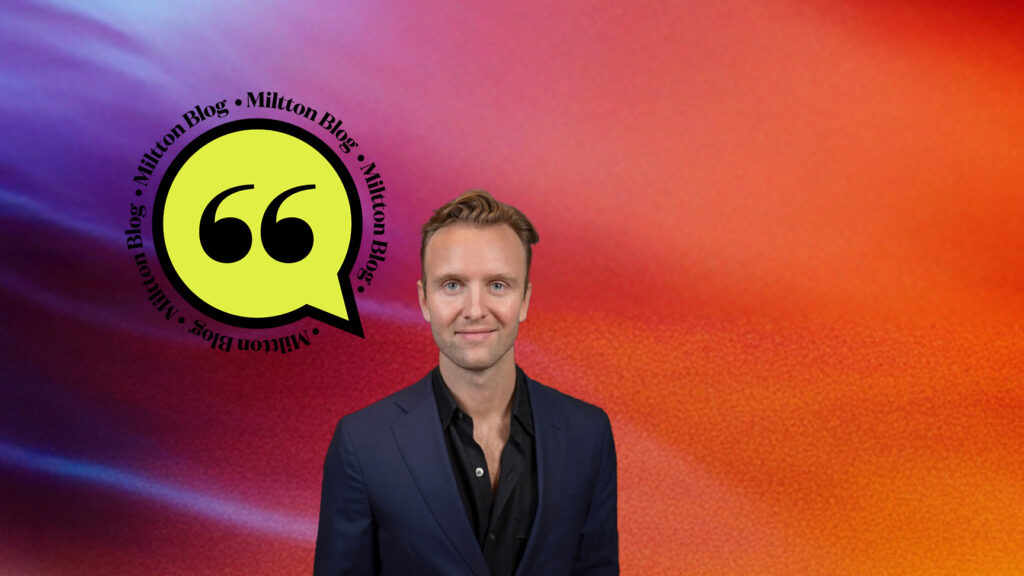
02 Feb 2026 Blog Sanna-Mari Jäntti, Head of new markets

Davos 2026: dialogue in a fragmented world

During this year’s World Economic Forum, Sanna‑Mari Jäntti noted that Davos 2026 offered no grand breakthroughs, only a blunt reality check. What she found instead was a forum mirroring a world slipping into a low‑trust, high‑risk equilibrium, where dialogue persists but action is increasingly narrow, interest‑driven, and shaped by geopolitical fracture.

Share

The World Economic Forum Annual Meeting 2026 did not deliver landmark global agreements. Instead, it offered something more revealing: a clear signal that the global system is settling into a new, lower-trust higher-risk equilibrium.

Davos this year reflected the normalization of geopolitical and economic fragmentation, a shift toward regionalism and pragmatic, interest-based coalitions, and a noticeably more sober, execution-focused tone. Dialogue remained active, but concrete action was increasingly framed through national interest, resilience imperatives, and competitive advantage rather than broad-based global consensus.

One of the most discussed political flashpoints was U.S. President Donald Trump’s stance on Greenland and the resulting strain on U.S.–EU relations. The episode underscored a broader reality. Geopolitics is no longer a background condition for economic decision-making, but a defining variable.

A forum in transition

The context of the meeting this year was unusually tense. Leaders arrived amid intensifying geopolitical insecurity, trade uncertainty, and declining confidence in multilateral institutions. While dialogue remained the organizing principle, outcomes pointed away from consensus-building and toward pragmatic cooperation, selective alignment, and deal-making among smaller groups.

Surface-level alignment existed around resilience, growth, artificial intelligence, and sustainability. Yet beneath that alignment, discussions revealed a widening gap between public-sector risk management and private-sector value creation. Many policymakers emphasized stability, sovereignty, and social legitimacy; many business leaders focused on predictability, capital efficiency, and speed of execution. The apparent execution gap between governments and markets was difficult to ignore.

While global economy growth has proven resilient despite geopolitical disruption, speakers warned that current rates are insufficient to reduce debt meaningfully or address structural inequality. The emphasis at Davos seemed to shift from acceleration to resilience. Growth alone, many argued, is no longer enough without structural reform and debt sustainability.

From AI optimism to AI realism

Artificial intelligence discussions marked a clear transition. The focus moved away from experimentation and tools toward redesigning work at scale, integrating people, intelligent agents, and automation into core operating models.

Business leaders openly acknowledged low returns on AI investments so far, citing skills shortages, governance challenges, and rigid operating models. Governments, by contrast, concentrated on AI sovereignty, regulation, and access to computing infrastructure. The overall tone shifted decisively from “AI optimism” to “AI realism,” with productivity delivery and execution replacing some of the previous hype.

Geopolitics as a structural variable

Geopolitical risk dominated the agenda. U.S.–Europe relations, instability in the Middle East, and systemic rivalry among major powers framed many discussions. European leaders emphasized strategic autonomy, territorial sovereignty, and defense readiness, signalling a more assertive European posture.

German Chancellor Friedrich Merz described the current moment as an era of “great power politics,” reflecting deteriorating norms in international relations. The meeting revealed little appetite for new binding multilateral frameworks, reinforcing the sense that global governance is fragmenting rather than converging.

U.S. President Trump’s remarks on Greenland and renewed tariff threats became a focal point, prompting European leaders to reaffirm sovereignty and accelerate discussions on strategic autonomy. Arctic security, energy policy, and climate geopolitics featured prominently in this context.

A central conclusion emerged: geopolitical risk is no longer an external shock. It is a structural economic condition.

Sustainability without rhetoric

Despite being overshadowed by geopolitics and economic risk, sustainability remained on the agenda – though in a noticeably altered form. Climate discussions received less attention than in previous years, and ESG rhetoric softened considerably.

There was broad agreement that a fossil-fuel phase-out is inevitable, that transition risks must be socially managed, and that private capital will not scale without policy clarity. Sustainability was increasingly framed as a security and competitiveness issue rather than a moral one. Governments emphasized direction-setting and compliance; businesses focused on economics, bankability, and returns.

The debate has shifted decisively from whether to phase out fossil fuels to how to do so strategically, with just transitions and renewable deployment at the center. This view was notably not shared by President Trump in his address. Meanwhile, India positioned itself as a key player in scaling renewable energy and attracting long-term capital, with Union Minister Pralhad Joshi highlighting the country’s ambitions.

Parallel programming expanded the sustainability lens beyond energy, emphasizing water ecosystems – from oceans to freshwater systems – as critical infrastructure for climate resilience, trade, food security, and global stability.

A more sober Davos

Davos 2026 did not produce grand breakthroughs. Instead, it offered clarity. The global system is adjusting to fragmentation, constrained trust, and higher risk. In the new normal dialogue continues, but action is increasingly selective, pragmatic, and interest-driven.

Got you interested?

Let’s talk more!