09 Nov 2026 Blog Heidi Kalmari, Senior advisor, Sustainability and Communications

COP31: Where tomorrow’s climate markets take shape

Climate action is entering a new phase. As COP31 brings governments, businesses and investors together in Antalya, the focus is shifting from commitments to implementation. Heidi Kalmari explores how companies can help shape the markets, investment and demand needed to turn tomorrow’s climate solutions into today’s business.

Share

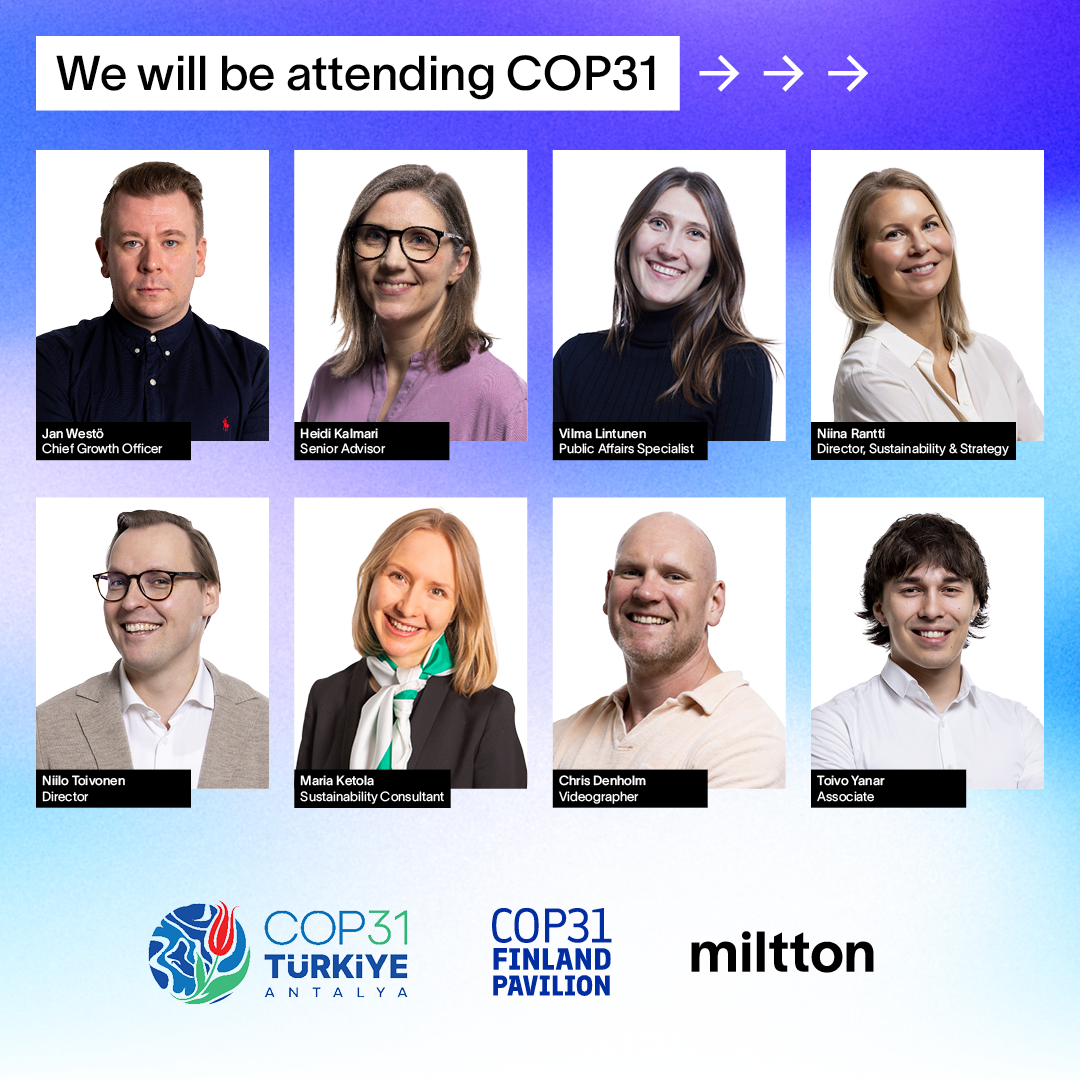
This week, the UN Climate Change Conference COP31 will once again bring together climate policymakers, businesses and civil society, this time in Antalya, Türkiye. At Miltton, we are proud to lead the production of the Finland Pavilion, together with Climate Leadership Coalition, the Confederation of Finnish Industries, Finland Chamber of Commerce, Technology Industries of Finland and UN Global Compact Network Finland, in cooperation with the Finnish ministries responsible for climate policy, foreign affairs and economic affairs.

This year’s COP has an unusual leadership structure. Türkiye will host the conference and lead its Action Agenda, focusing on practical climate solutions, while Australia will chair the formal negotiations.

Around 100,000 participants are expected to gather in Antalya. Alongside government leaders and negotiators, there will be businesses, investors, scientists, NGOs and many others working to advance the climate transition.

COP conferences are often criticized for becoming enormous international trade fairs. And it is easy to understand why, considering their growing scale, costs and environmental footprint.

But there is also a good reason why COPs have evolved into meeting places for businesses and other stakeholders alongside the political negotiations. Climate action has entered a phase where commitments and targets need to translate into concrete action. And that requires companies that invest, innovate and bring solutions to market.

At the same time, the work of businesses and other stakeholders create also pressure for even stronger political decisions. As technologies advance, investments accelerate and markets grow, more ambitious climate policies can become politically possible. The political landscape has also changed as a lot of elections have been held recently. For example, after the US midterm elections, there has been talk about climate issues making a comeback in the US politics.

This is an interesting perspective on the sometimes frustratingly slow progress of international climate negotiations. Paris agreement was made in 2015, but it was only at COP26 in Glasgow in 2021 that fossil fuels were explicitly mentioned in a COP decision for the first time, through language on reducing unabated coal power and phasing out inefficient fossil fuel subsidies. At COP28 in Dubai in 2023, countries agreed for the first time on transitioning away from fossil fuels in energy systems. Meanwhile, clean energy technologies and their markets had already been developing for years.

Expectations for major breakthroughs in the formal negotiations at COP31 are initially modest. In recent weeks, however, expectations have risen somewhat, as Australia has announced plans to prepare a political cover decision. Its content is still open, and it will be interesting to see what kind of shared political messages emerge from the conference.
Electrification and the Action Agenda take centre stage

One of the most interesting developments at this year’s COP is the growing importance of the Action Agenda, which connects international climate goals with practical solutions, investments and partnerships.

A flagship initiative of Türkiye’s presidency is the 35-by-35 Global Electrification Pledge, aiming to increase electricity’s share of global final energy consumption from just over 20% today to 35% by 2035.

Electrification offers significant opportunities to reduce emissions across industry, transport and buildings. Combined with clean electricity generation, it can accelerate the transition away from fossil fuels.

The initiative has also been positively received by Finnish business organisations, and for good reason. Finland has considerable expertise in clean electricity, industrial electrification and energy system technologies. Electrification is, of course, not the only solution, but it is one of the most important ways to accelerate emissions reductions.

It will be interesting to see how much international support the initiative gains and whether electrification also finds its way into the political cover decision at COP31.

How do we turn tomorrow’s climate solutions into today’s business?

Ultimately, the pace of the climate transition depends largely on how quickly lower-emission solutions can be deployed and scaled. For many solutions, the challenge is no longer only technological, but also commercial: how do we create demand and unlock investment when markets are still emerging?

This is a question we are also exploring at Miltton. We increasingly talk about market shaping: actively building the markets that climate solutions need to succeed. Companies cannot simply wait for markets for lower-emission solutions to emerge. They can help create them.

We need customers and major buyers to create demand, companies to develop and scale solutions, and investors and financial institutions to provide capital. And, of course, policies and regulation that support this development.

The recipe sounds simple, but putting it into practice is an enormous collective undertaking. New solutions must compete with established technologies, infrastructure and business models. Changing markets requires not only investment and collaboration, but also political decisions that make lower-emission alternatives competitive.

This is exactly what we want to explore in Miltton’s own COP31 event at the Finland Pavilion on Thursday, 12 November. Miltton’s Director for Sustainability Business Niina Rantti will open the discussion by looking at how companies can anticipate future markets and demand and use those insights to make investment decisions today. The keynote will be followed by the conversation with representatives from Neste and Danske Bank, exploring what it takes to scale and finance climate solutions in practice.

Perhaps this is one of the most important roles of COP conferences: bringing together those who can accelerate change through their decisions and actions. And, at the same time, building pressure for international climate policy to keep pace with that change.

The Era of Implementation: Who Is Really Driving the Climate Transition? Contact Miltton’s team at COP31

Miltton | Finland Pavilion, D515 | Thursday, 12 November 2026 at 4 PM

Find out more

Interested?

Let’s talk!