Washington, D.C.: Signal and Noise
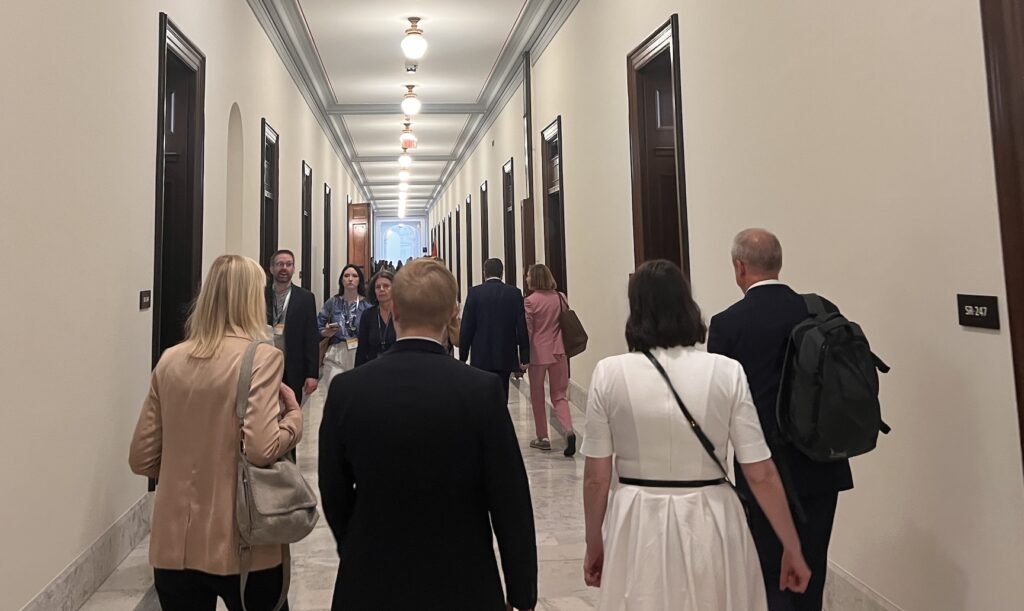
We travelled to Washington D.C. to hear what people who actually sit inside the machinery think; former diplomats, lobbyists, think-tankers, those who’ve served multiple administrations, and congressional staffers, all of whom spend their days trying to work with and understand what D.C. is thinking and why it’s doing what it is. The travelling fellowship, made up of senior representatives from well-known Finnish companies and organizations, was there to gather material and insights for a scenario-building process led by Nordic West Office. The end result of the project is a set of future scenarios covering the globe. This trip focused on the United States and its global role. During this trip, I took more than thirty pages of notes. I’ve picked two insights to share.
The first was ‘the data center anecdote’. As relayed, an individual at a D.C. cocktail party, when asked what he did for a living, declined to say. He built data centers in nearby Virginia. It turns out that being associated with building the physical infrastructure of the U.S. economy’s most celebrated growth story was not something to admit to, even Virginia, in the ostensible nerve center of America’s AI-led data center boom. Clearly, the communities where the infrastructure is actually built are not nearly as eager as the tech barons arguing in near-messianic terms that the AI-buildout must continue because “the payoff will come.” The power price spikes, dropping water tables, worsening air quality, and interconnection queues are causing actual problems that cannot be swept under the rug.
The second observation is about Europe and how a specific narrative has moved. The baseline expectation across D.C. is that Europe must be able to take care of its own conventional defence within the coming decade, irrespective of who occupies the White House from 2029 onwards. The discussions revolve around different terms of the new transatlantic defence balance. U.S. defence firms understand that European procurement euros will, for political, capability, and hedging reasons, increasingly flow to European industry. Co-production and localisation discussions between American and European companies are ongoing, but some in D.C. still want to ensure that Europeans continue to buy American weapons. However, production-capacity shortfalls within the U.S. are themselves an argument for European industrial autonomy; Allies must not assume that the United States can produce enough weapons for itself or to sell to allies.