03 Jul 2026 Blog

The new reality of transatlantic cooperation

Signals coming from Washington are contradictory, decisions change overnight, and their impact reaches across the Atlantic at a pace that can make businesses, diplomats, or policymakers head spin. Yet it is precisely in this now everyday unpredictability that we should remember why the relationship between Europe and the United States has historically been so strong—and why preserving it is in Europe’s interest. Sandra Kamilova, Head of Public Relations at Miltton New Nordics, and Kristiina Helenius, Head of Miltton USA, analyze what this new reality means for transatlantic cooperation.

Share

In an ideal world, we act together with the U.S.

Transatlantic cooperation has been one of the cornerstones of European security and the international order since World War II. It has fuelled economic growth, supported innovation, and given our region greater political weight on the international stage. For the United States, Europe has been simultaneously a large and profitable market, an ally, and a shared value space through which we have, by relying on each other, managed to preserve the influence of the democratic world even when the international order has been under pressure.

The current situation is forcing Europe out of its comfort zone and to rethink its role. Remaining in a waiting position is becoming increasingly unsustainable over time. This inevitably pushes Europe toward greater coordination and more confident advocacy of its interests. Europe should pursue pragmatic economic and security policies, recognizing that each new situation may require new solutions.

We could start with more unified action in security matters, significantly increased investment in defence capabilities, and a stronger industrial policy to remain competitive as the EU. The EU should use today’s instability and the constant state of crisis to assert itself as a global actor. The EU is one of the world’s largest democratic single markets, with a strong shared value base, and we are moving toward better collective defence capabilities—but we aim for more. In an ideal world, we would, of course, do this together with the United States.

Security concerns deepen, but Europe is awakening

In recent weeks, increasingly alarmist discussions have emerged about the withdrawal of U.S. troops from Germany, followed by confusion over force rotations in Poland and debate about a possible U.S. departure from Lithuania. These developments directly affect Europe, in particular the Baltic region, as our security depends on deterrence, allied presence, and—at least until now—the assumption that NATO can act quickly in a crisis.

To some extent, this new reality has also been recognized elsewhere in the European Union, and major EU countries have started to move in the necessary direction, albeit still not fast enough. The divide between eastern and western Europe persists, but western EU countries are beginning to understand that the rapidly shifting security situation closer to their eastern border may ultimately affect them directly as well. All this leads logically to the same conclusion: more coordinated European action and the creation of a shared defence capability are clearly in Europe’s own interests.

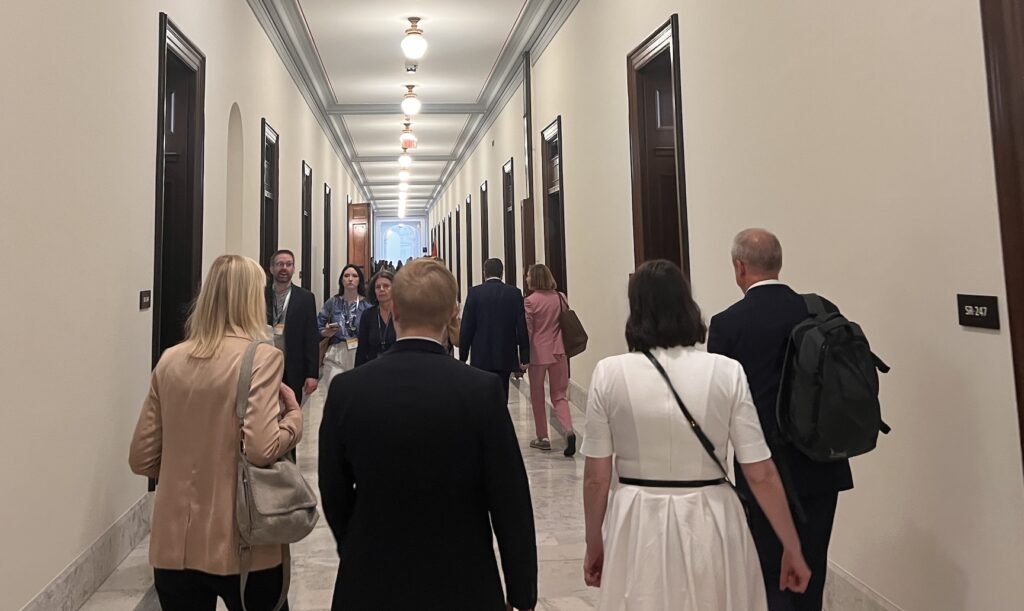
Relations with Washington do not sustain themselves, especially at a time when traditional institutional channels may be weaker, many positions remain unfilled (for example, more than one hundred U.S. embassies worldwide currently lack ambassadors), and political attention is fragmented. For a small country like Estonia, this means we must consistently be present, engaging with the administration, Congress, decision-makers at the state level, officials, and business leaders. It certainly helps if we are seen not only as a consumer of security, but also as a provider of solutions in areas where we truly have something to offer.

A glimmer of change in Washington?

Last week, two highly significant developments took place in the House of Representatives. First, with the help of Republicans voting alongside Democrats, a long-delayed decision was passed to continue support for Ukraine and adopt a package of sanctions against Russia. A day earlier, four Republicans joined Democrats in supporting a resolution aimed at limiting the president’s ability to continue military action in Iran without clearer congressional approval.

These decisions will not change things overnight, especially since the Senate still lies ahead and, at least regarding the first issue, the president may veto the outcome. However, they show that some kind of shift is taking place in the United States—one that appears to be nudging developments slightly in a direction that is more understandable from our perspective.

U.S. midterm elections, which will likely reshape the balance of power in both the House of Representatives and the Senate, are scheduled for November 3. Based on current polling, it can be cautiously assumed that Democrats may succeed in strengthening their position. The outcome of these elections could significantly affect both support for Ukraine and the administration’s room for maneuver in foreign and defence policy more broadly, so it is worth watching closely.

It is also worth remembering that, traditionally, hardliners on Russia have more often been Republican presidents and administrations. But that illustrates that previous assumptions no longer necessarily hold true.

Strong relationships require more effort in difficult times

The U.S. midterm elections will take place on November 3. Their outcome could significantly influence both support for Ukraine and the administration’s flexibility in foreign and defence policy more broadly, making it important to monitor them closely.

At the same time, voices occasionally emerge in Europe arguing that transatlantic relations, in their current form, have run their course. While value-based distancing might feel emotionally satisfying in the short term, it would be a dangerously simplistic conclusion. The United States is a global power in every sense—a country of 340 million people (compared to 450 million in the EU), with a strong civil society and an extremely multilayered political system that relatively few in our region fully understand.

For Europe, the United States has been a partner of central importance in terms of security policy, but the economic dimension is also significant—both directly and indirectly. Although direct exports to the U.S. play a major role in Europe’s economy, the overall impact of U.S. policies extends far beyond trade flows alone, affecting Europe through broader export dynamics, global supply chains, and shifts in investment confidence. Europe is already highly visible for its technological capabilities and innovation potential, and its diplomatic networks play a consistent and substantive role in this area. The next challenge lies in amplifying this work even more systematically—expanding economic and technological partnerships, increasing the visibility of Europe’s practical solutions, and actively participating in international networks that shape global perceptions.

The current moment requires maturity and strategic cohesion from the European Union. However, a realistic and pragmatic approach does not have to mean abandoning transatlantic cooperation and plunging into uncertainty. Rather, it means adapting—with the understanding that strong relationships require more effort in difficult times than they do in comfortable ones.

Want to hear more? Contact us