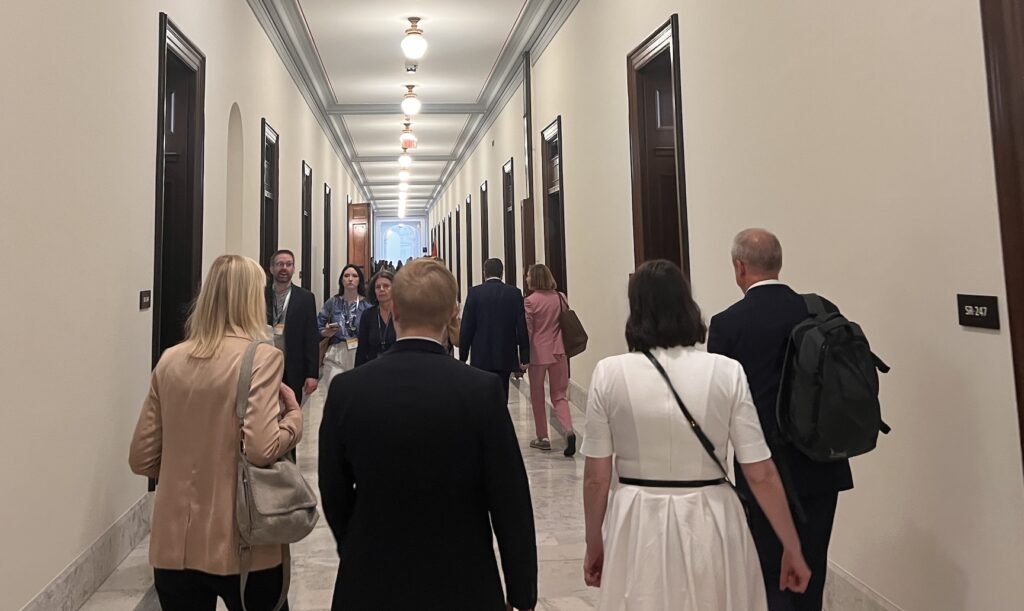
Our Global Scenarios journey continues, and this time it took us to the center of European decision-making: Brussels. To outsiders, it is often portrayed as a city of bureaucrats with its endless maze of institutions, acronyms, working groups, and directives. Yet, that bureaucracy is exactly what makes Brussels one of the world’s most influential political centers. However, looking at it from the inside reveals a system actively trying to evolve in response to a rapidly changing world. Of the many politically important cities in the world, Brussels perhaps better than any symbolises interdependence, voluntary integration and ponderous decision making. All three are in evidence when it comes to the most frequently touched topic in Brussels at the moment: security.
Building global scenarios 2035 – trip to Brussels
In Brussels, security is no longer just about defence. In this latest dispatch from Miltton’s Global Scenarios journey, Charly Salonius-Pasternak reflects on how Europe is rethinking resilience, economic security and strategic autonomy amid a rapidly changing geopolitical landscape.
Security reaches far beyond defense
Traditionally viewed through a military lens, security is now understood much more broadly. It includes energy, trade, technology, supply chains, food systems, and societal resilience. As was apparent in almost all our discussions, Finland is seen as being a forerunner in integrating sound broad security thinking across these fields. Yet, every country has lessons to be extracted on how to make societies more resilient to a range of natural or man-made challenges. One particularly apparent shift was the ever tightening link between economics and security in most discussions. While this serves a clear purpose in the current context, the trade-off is that it overly focuses the economic debate on security and thereby often towards risk management as opposed to opportunity identification.
While the European Union more clearly ‘owns’ economic security, our meetings also made it clear that NATO continues to own European defense. Moreover, as the U.S. is increasingly focused elsewhere, European members of the Alliance are expected to take greater responsibility for Europe’s conventional defense and security. Two realities were apparent in most discussions. First, that due to transatlantic politics, the ongoing war in eastern Europe, and increasing instability globally, Europe has a chance to see economic growth through the defense sector. Second, new forms of cooperation are emerging as smaller groupings of states and ad hoc coalitions are rising around traditional NATO structures, moving from discussions to operational cooperation, as well as offering more flexible and faster decision-making where needed.
China and Europe’s strategic balancing act
Another theme that is impossible to avoid when discussing the future of the EU is China’s role. China was consistently framed not just as a competitor in specific sectors, but as a force reshaping Europe’s economic and industrial environment more broadly. Because of China’s systemic influence, the conversations revolved around managing exposure, not the simplistic “China or no China” framing. The focus is on how dependent Europe can afford to be in critical sectors and how to make it more resilient to different forms of economic pressure. Perhaps suitably to Brussels and its frequent focus on process, discussions often focused on value chains and industrial ecosystems, where Chinese policies, production patterns and outputs are increasingly seen to have national and system level impacts. China is a competitor and a key market and supplier, and its ability to leverage trade, exports, and critical inputs introduces a constant element of uncertainty into Europe’s strategic calculations. The balance the EU is seeking is between reducing vulnerabilities and staying economically open.
Looking ahead, the questions Europe is grappling with do not stop at its borders. The next destination of the Global Scenarios program is Singapore, where the focus shifts to Asia and the Global South, and how these regions are shaping, and being shaped by, the same forces of interdependence, competition, and resilience.
Want to hear more?
Let’s talk!

Charly Salonius-Pasternak
CEO of Nordic West Office Miltton Group +358 407 540 151 charly.salonius-pasternak@miltton.com