22 Jun 2026 Blog Kristiina Äikäs, Nora Kolari

London brand diaries, chapter 2: how to stay real with discipline

In chapter 2 of our London brand diaries, Nora Kolari and Kristiina Äikäs take on a tougher question: what does “real” actually mean for brands today – and can it be engineered? From hyperlocal campaigns to carefully crafted café aesthetics, London becomes a test ground for authenticity, discipline, and the fine line between human insight and AI-powered precision.

Share

Hello from the London heat. The hottest question this week is not the weather, although speculating about British summer would be a very on-brand thing for us to do. We are here to talk about something that has been following us around the city like a well-targeted ad: what does real actually mean for brands right now, and does it matter who or what made it feel that way.

AI is making us think we can manufacture authenticity at scale. And maybe we can. But the quest to find things that genuinely resonate has reached a point where we need to figure out what we actually need it for, which areas of life it serves, and whether there are limits to that. Walking around London, we couldn’t help but wonder where the narrative stems from and what the relationship is between AI-assisted brand thinking and human-centered storytelling. Because the city kept serving us examples that felt achingly specific and human – and we kept asking ourselves whether that specificity could have been engineered. London, as it turns out, is an excellent place to road-test the question.
The canal run and the CFO who clicked the link

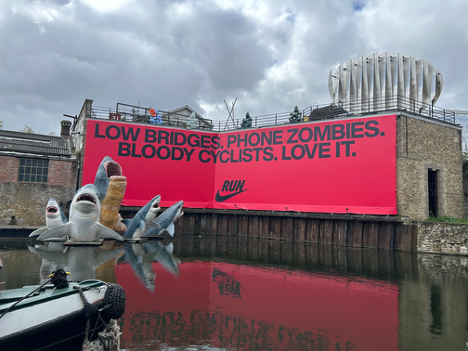
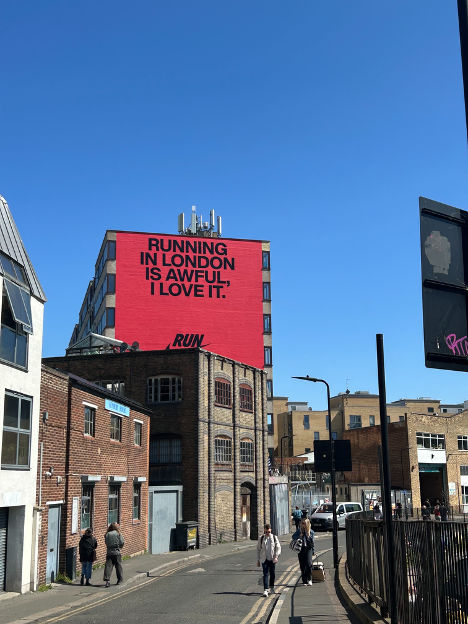
Running by the canal in London is, objectively, horrible. Low bridges. Phone zombies. Bloody cyclists. Nike’s campaign plastered across East London buildings doesn’t pretend otherwise. It leans into the misery with such precise affection that it becomes a love letter. The message is hyperlocal and emotionally communal – it says we know your specific, grimy, wonderful experience and we are here for it. That kind of insight used to live in a creative director’s gut. Today it can be surfaced by an AI trained on millions of runner forums, Strava comments, and London Reddit threads. The output feels human because the input was. That level of precision comes from actually listening.

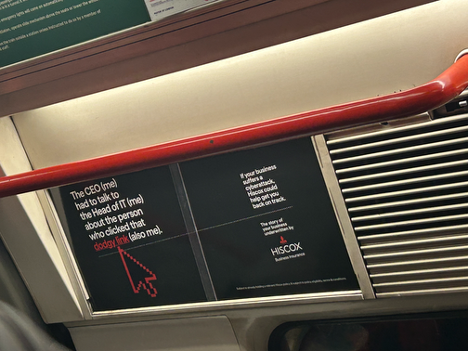
Then there’s the Tube ad that stopped us in our tracks. Hiscox, a business insurance brand, ran a campaign that read: “The CEO (me) had to talk to the Head of IT (me) about the person who clicked that dodgy link (also me).” One sentence. Every small business owner on that carriage felt personally seen, probably slightly ashamed, and quietly grateful. That is emotionally intelligent B2B communication at its sharpest – no jargon, no fear-mongering, just the exact texture of a very recognizable bad day. The precision of that narrative is exactly what AI-assisted consumer insight can unlock: not the average experience but the specific one, the one that makes someone on the Tube look up from their phone.

These two campaigns, one consumer and one B2B, share something important. They reached for specific over universal, and specificity is what made them land.

Hyperlocal, self-aware, and completely unavoidable. Nike knows exactly where you are and how you feel about it.

Jolene and the gentrification of authenticity

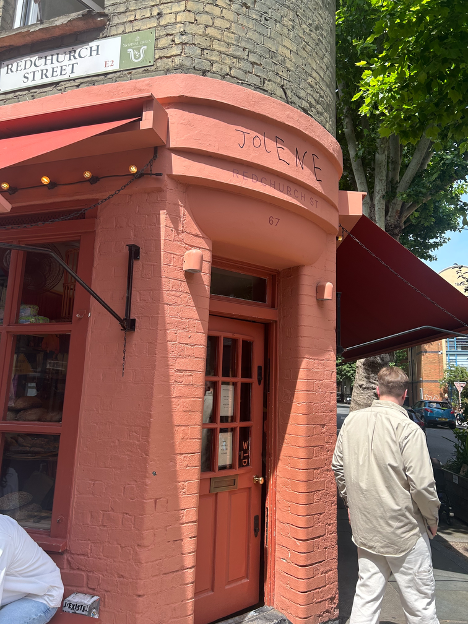
As we made our way towards the office, we came across Jolene, the coffee shop on Redchurch Street in Shoreditch. The whole corner is painted in the same warm terracotta. The signage is handwritten. The bread is visible through the window. You will absolutely see someone with glasses reading a physical book inside. The brand has gathered genuine praise for its down-to-earth approach, and the food is by all accounts excellent. But standing outside it, you can’t help wondering whether authenticity has been so thoroughly designed that it has looped back around to become its own kind of performance.

Shoreditch has been trendy long enough that its trendiness is now self-aware, which makes Jolene either the last honest thing on the street or the most sophisticated act on it. Possibly both. This is where the AI lens gets uncomfortable. If the vocabulary of realness (the terracotta, the handwriting, the visible sourdough) can be identified, codified, and replicated by a system trained on a thousand successful independent cafés, does the original still mean what it meant? The interesting question for brand thinking is not whether Jolene is real (it probably is). When AI learns what authentic looks like, anyone can make a Jolene. And then what separates the real one?”

Who Gives a Crap and the toilet paper that became a personality

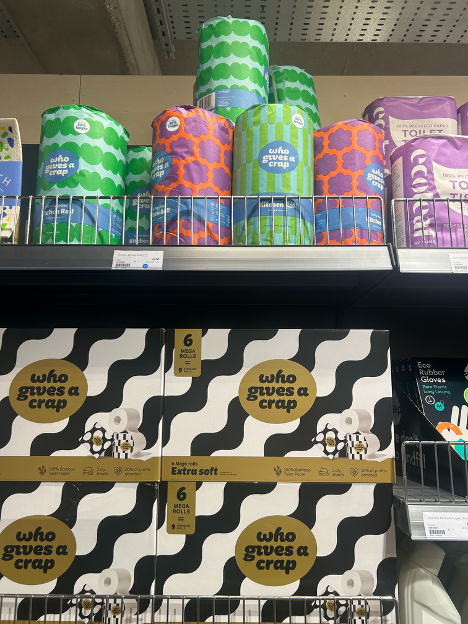
Toilet paper is the category that nobody thinks about until someone makes them think about it. Who Gives a Crap managed to do exactly that through packaging so bold, so deliberately joyful, that people started leaving it on the back of their toilet as a design object. It donates 50% of profits to sanitation projects. The name is a pun that is also a mission statement. The patterns are maximalist and the brand voice is relentlessly cheerful without tipping into insufferable.

It is a useful case study because it proves that the category doesn’t determine the ceiling. It also raises the AI question from a different angle: Who Gives a Crap’s entire identity is built on a genuine mission, and the personality flows from that. An AI can replicate the aesthetic and even the tone. What it cannot replicate is the decision to donate half your profits, and that decision is what gives the whole thing its integrity. The question is never whether your product is interesting enough for a strong brand. The question is whether you have the discipline to commit to a point of view and the creativity to make it feel alive.

What the city is telling us

Walking around London this week, what struck us was not the volume of brand activity but the quality of the ones that cut through (and the nagging question of what combination of human and machine produced them). The honest answer is that we often couldn’t tell, and that is both the promise and the provocation of this moment.

What the city kept showing us points to something we’ve been building towards: brands that endure need three things working in parallel. A human narrative specific enough to be felt and a design system governed well enough to scale. And most importantly, the discipline to behave consistently whether a person or an algorithm is on the receiving end.

London is still on the line so stay tuned for the next chapter.

Interested?

Let’s talk more!